AI Can’t Read Your Damn Website (humans can’t either)
The Funnel Moved. Now What?
A few weeks ago, I wrote about how I think the funnel moved - or at least - is actively moving.
Not disappeared. Not “broken.” Moved.
The more I studied the changes happening in AI-referred traffic, the more convinced I became that a growing portion of discovery, comparison, evaluation, and persuasion may now be happening before someone ever reaches a website. LLMs are increasingly acting like intermediaries between brands and buyers, synthesizing information from reviews, forums, websites, social conversations, product listings, documentation, and community discussions into recommendations and summaries long before any clicks bring users to our websites.
That article was really about the behavioral shift itself.
Now, I want to talk about something else: what we actually DO about it.
And honestly, the more I talk to accessibility experts, technical SEO experts, and people working on AI discoverability, the more I read in these areas, the more I feel like I’m watching three historically separate conversations suddenly collide into one. Honestly, they probably should have always been a single-thread conversation (and maybe people much smarter than me knew this or were already working with their peers across channels) - but I can tell you, it’s not been my default experience.
It’s Like Déjà Vu All Over Again
For years, accessibility experts have been telling us:
structure content clearly
use semantic HTML
improve keyboard navigation
label things properly
reduce unnecessary interaction friction
simplify experiences
improve readability and comprehension
For years, technical SEO experts have been telling us:
improve crawlability
reduce rendering complexity
improve site speed
structure information clearly
reduce JavaScript dependency
expose content cleanly to machines
And now, people focused on AI discoverability are saying many of the exact same things!

The overlap is striking.
Even Google’s emerging guidance around agent-friendly websites increasingly sounds like a blend of accessibility guidance, technical SEO recommendations, and usability best practices. Semantic clarity, clean structure, explicit labeling, crawlability, reduced dependency on user interactions, and machine-readable flows repeatedly emerge as foundational requirements for AI agents navigating the web.
These conversations are starting to sound remarkably similar.
Personally, I’ve spent most of my career pushing for research, optimization, and experimentation efforts grounded in human-first concerns. Not “what can we change to increase clicks?” but “what problem are we solving?” “What friction are we removing?” and “What would actually make this easier, clearer, or more useful for another human being?”
Our friend Erin Weigel does things, and she has a phrase I love so much I literally tattooed it on my arm:
“Make things better, not just different.”
And yes, there is photo evidence (of course):
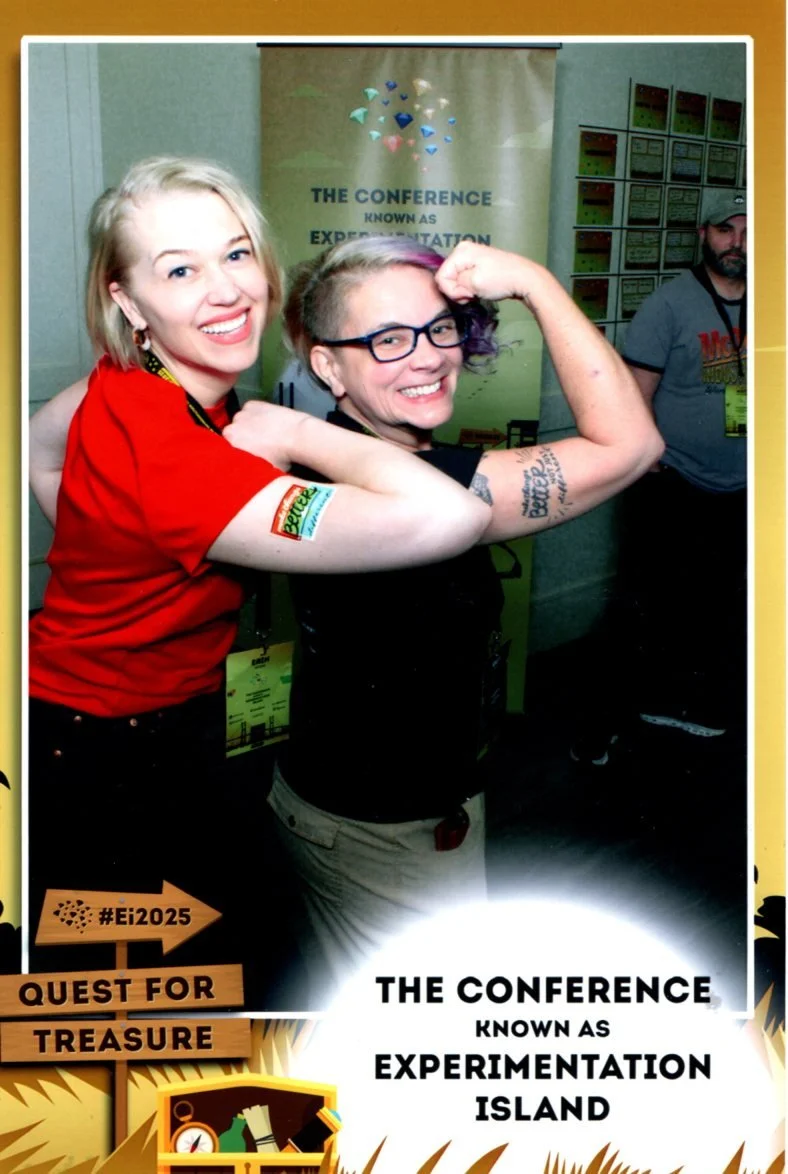
That idea shaped how I think about experimentation (before Erin put it into such perfect words).
Because changing things just because we can was never the point.
And honestly, I think parts of our industry lost the thread for a while. “Move fast and break things.” “Fail fast.” Those ideas became innovation mantras during a particular era of digital growth, but I’ve never fully agreed with them. Not because experimentation should be slow, but because experiments should have purpose.
Randomness is not learning.
Making users repeatedly adapt to constantly shifting interfaces, messaging, and experiences without a meaningful reason behind the change is not customer-centered. And asking teams to continuously build work because “the test will tell us” if it made us money creates organizational fatigue without purpose.
Stuff loses meaning when it isn’t tied to a real problem.
The most innovative and impactful programs I’ve seen were never optimized solely around velocity. Velocity does not equate to innovation.
Instead, the best programs focused on understanding where customer problems existed, how to solve them, documenting what they learned, and recognizing that scaling growth and innovation required institutional learning and sharing. In short, they focused on continuous improvement through learning.
And honestly? They weren’t obsessing over conversion rates every second of every day.
They focused on understanding customer problems. Solving those problems and delighting customers (both internal and external customers) is exactly how experimentation should work. At the end of the day, that’s how revenue is made.
But when revenue and conversion rates become the primary drivers, programs often start optimizing the wrong levers.
And honestly, I think that’s part of why this current shift around accessibility, semantic clarity, technical SEO, and AI discoverability feels so interesting to me.
Because maybe this moment pushes us back toward building things that are actually clearer, easier to use, easier to understand, and more useful for humans in the first place.
Something is Happening - Data Shows it
Increasingly, there’s evidence that this convergence is real.
The G2 report on AI search behavior found that buyers are increasingly beginning research journeys inside AI systems instead of traditional search engines, often arriving onsite much later in the decision-making process than they historically did. (NOTE: the brand-spankin’ new news out of Google may change all of this - at least for Google Pixel 10 & Samsung S26 when Gemini will come standard with “auto browse” on Chrome… I’m sure more will follow, which will take several folks away from OpenAI, Anthropic, et al. Thanks, Sani, for pointing this out.)
Speaking of Sani…Sani Manic’s analysis of Adobe’s AI-referred traffic trends found that while AI traffic volume remains relatively small, the quality and intent of that traffic appears disproportionately high, suggesting users arriving from AI systems may already be heavily pre-qualified. (Duh).
Our friend Ton Wesseling described this shift perfectly when he wrote:
“The decision happens before the click.”
Think about that for a minute - or for several minutes. Because it has profound implications on what we do as experimenters (or UX researchers, or copywriters, or basically anything in our field…)
Because if the persuasion, comparison, and synthesis stages increasingly happen before the click, then websites may be shifting from discovery layers into confirmation layers.
And if that’s true, then clarity suddenly matters a lot more than cleverness.
(I feel like I want to insert the trumpet dun dun dud sound. Not a music major - is that a trumpet?)
Beautiful Websites Confuse Machines
Jono Alderson has spent years warning that we’ve over-engineered the web into increasingly fragile, inaccessible, machine-hostile systems optimized more for development trends than human understanding.
At the same time, AI systems increasingly rely on structured interpretation, semantic clarity, and machine-readable meaning.
Those two trends are colliding. And I think that collision is going to matter a lot.
We built increasingly complex experiences:
hidden behind accordions
dependent on JavaScript rendering
overloaded with carousels (stop it!)
filled with interaction-dependent discovery patterns
designed more for aesthetic novelty than comprehension
No more accordions. Death to carousels.

In short, stop hiding critical information behind interactions, visual tricks, excessive rendering complexity, and navigation patterns that make humans work harder, and machines struggle to interpret meaning.
Because increasingly, we are designing simultaneously for:
humans
screen readers
crawlers
accessibility tools
AI systems
AI agents
And the organizations that communicate the most clearly may be the ones who succeed across all of those audiences.
Your Website Ain’t a Destination Anymore…
Sani’s got a lot of banger content out these days. If you’re not following NoHacks, you’re WAY behind. In one of his recent articles, he pointed out,
“Your website is not a megaphone.”
That stuck with me because it reframes the website from a mechanism brands use to carefully curate their story the way they want to tell it, where they are holding the megaphone, into something more like a structured source of information that AI systems, search engines, accessibility tools, and users all interpret differently.
They’re rifling through your systems and pulling whatever information they deem relevant to the user’s question. And it might not be the thing you wanted highlighted. It could be an outdated feature, a deprecated product, an inaccurate inventory message, an old support article, or a forgotten review sitting on some third-party site you haven’t touched in years.
Websites are increasingly being consumed non-linearly.
AI systems don’t experience websites the way humans do. They extract, synthesize, compare, summarize, cite, and recombine information across ecosystems. They don’t traverse your navigation the way a human would. They don’t admire your animations. They don’t care how clever your carousel transitions are. (Trust me - humans don’t like your carousels, either. Yes, I said it twice. I meant it twice.)
They care whether they can pull the data needed to answer the user's question.
And honestly, I think many folks are guilty of optimizing digital experiences for visual theater rather than for understanding. Take a moment to look at your website. How much of the site is visual? Animations? Carousels? (we already discussed this, dammit!) Do you have FAQs? Good job! Are the answers hidden in accordions? Of course they are. Why wouldn’t they be? Well - AI systems aren’t going to click-to-expand. So - all that great content…lost. Maybe they’ll solve for that later - but maybe you can put those answers somewhere the AI can scrape without impacting user experience? (Not a technical SEO expert nor developer here if you can’t tell… I don’t even play one on TV. But - ask your friendly neighborhood experts. We have to solve for this!)
Accessibility as a Growth Strategy 🥳
This is where we finally help leaders realize that accessibility is much bigger than compliance.
Accessible websites are easier for both humans and AI systems to understand because AI crawlers rely on the same semantic structure and content organization that assistive technologies use. Or, in other words,
“Accessibility isn’t a feature you add. It’s the foundation everything else builds on.”
Google’s latest AI optimization guidance seems to push back on the growing “GEO” trend industry. Rather than rewarding prompt-stuffing or AI-specific tricks, Google continues to emphasize the same core principles that have always mattered: useful content, semantic structure, accessibility, and machine-readable experiences. Whatddya know? Putting the human in the center is still the way to go!
Sani points out that, “invisible to Google Search” does not necessarily mean “invisible to AI.” Content excluded from traditional Google Search indexing may still be accessible, interpretable, and actionable to AI agents, LLM crawlers, browser agents, and retrieval systems.
Semantic structure, alt text, logical hierarchy, descriptive labels, readable navigation, and machine-readable content are no longer just “good accessibility practices.” It’s no longer just about compliance. They increasingly appear to be foundational infrastructure for AI discoverability as well.
That overlap matters. A lot.
Because accessibility experts have spent decades solving problems related to:
interpretation
clarity
navigation
semantic understanding
assistive interaction
cognitive load
structured meaning
And now, AI systems care about many of the exact same things.
That doesn’t mean accessibility and AI discoverability are identical disciplines.
But it does suggest they may be converging around the same underlying principles:
clarity
structure
semantics
usability
readability
meaning
And honestly, I think experimentation teams are uniquely positioned to help organizations explore this intersection responsibly. And, most importantly, putting the human where they belong - front and center.
This Doesn’t Mean We Stop Experimenting
To be clear, none of this means experimentation teams should stop running experiments.
Honestly, I think there are more interesting experiments to run now than ever before.
Accessibility experiments are fantastic experiments. They often improve usability, reduce friction, support broader audiences, improve clarity, and can absolutely produce measurable business impact. Some of the most impactful experiments I’ve seen are accessibility experiments!
And where we can, we should absolutely continue using randomized controlled experiments to measure impact.
But I also think we need to start thinking more broadly about what optimization can look like.
Not every meaningful intervention occurs cleanly at the individual-user level.
Some randomization can happen at:
the template level
the product-line level
the ecosystem level
the infrastructure level
And those environments may require different validation approaches:
difference-in-differences analysis
time-series analysis
quasi-experimental designs
mixed-methods research
observational analysis
and triangulation across multiple data sources
SEO experimentation has always been messy. Infrastructure changes are messy. Ecosystem effects are messy.
That doesn’t mean they aren’t worth doing!
Offsite Ecosystems Are Part of the User Experience Now
Seer Interactive is another brilliant organization full of brilliant people you should be following right now. They are writing incredibly smart things and are absolutely one of the few companies I would trust to be “in-the-know” about this stuff right now. And one thing they said recently really resonated with me. The TL;DR: “What AI thinks about your brand is already written.” That’s both slightly terrifying and probably true.
Because increasingly, AI understanding of your brand may emerge from:
reviews
forums
Reddit threads
third-party listings
documentation
social conversations
comparison sites
employee reviews
community discussions
not just your website.
And to me, that’s exciting. Because that creates entirely new playgrounds for experimentation.
For example, in a recent Knowledge Distillation Podcast conversation I had with Katrin Ribant, I discussed using product lines as randomization units for broader ecosystem experiments.
Imagine selecting Product Line A as a variant and Product Line B as a holdout.
Then, improving the broader ecosystem around Product Line A:
refreshing outdated reviews
improving third-party listings
increasing specificity in product descriptions
improving structured information
participating more actively in relevant communities
improving accessibility and semantic clarity
Then, observing differences over time for product line B vs A in:
AI referral traffic
conversion efficiency
branded search behavior
recommendation frequency
how AI systems describe Product Line A relative to Product Line B and competitors
That’s still experimentation.
It’s just experimentation operating in a broader and messier environment than a traditional landing-page test. You can even look at various forms of quasi-experimentation, diff-n-diff, etc.
And honestly, I think experimentation folks are uniquely equipped for this moment because our field has always been about learning under uncertainty. We know we can only reduce it.

Maybe This Pushes Us Back Toward Better User Experiences?
The Stanford HAI AI Index Report repeatedly points to growing gaps between AI adoption and organizations’ ability to measure, govern, and interpret the systems they are deploying. That feels deeply relevant to this moment.
Because I don’t think this is just an SEO conversation.
I think this is a broader conversation about how humans, machines, interfaces, and information systems are reorganizing in real time.
And it would be deeply ironic if the AI era ultimately pushed us back toward building websites that are:
clearer
faster
more understandable
more accessible
and more useful for humans
I think that would be a very good thing, don’t you?