Authenticity: The Cheat Code to Influence and Wellbeing.
Vibe coding builds the test. It still takes a human to get the yes.
Vibe coding is a thing now. People are building great things, doing amazing things that weren’t possible before. Running faster. Building faster. Removing roadblocks that used to eat entire sprints. Someone fires up their AI tool of choice, describes a change in plain English, and watches it get coded up in minutes-no engineering ticket, no two-sprint wait just to find out if a new product or feature actually works.
Sadly, you might be able to use AI to develop the idea in an afternoon from concept to ready-to-launch code, and still watch the whole initiative stall out in the meeting where someone actually has to say yes to it. Not because the feature or product is a bad idea. Not because it's too risky. Not because there isn't enough traffic. Because somebody in that room feels like no one talked to them first. No model, no matter how good, can vibe its way through the politics. That part is still, stubbornly, entirely human. (yay! Job security…)

Credit: Parks and Rec
Here's our metaphor. You're planning a party. Not just any party, an onboarding party, the kind where the whole point is a room full of strangers actually knowing each other by the end of the night. So you do what any efficient person does now. You hand it to an algorithm. It picks the perfect playlist, the perfect food, the perfect drinks, easy little bites you can hold in one hand so nobody's fumbling a plate mid-conversation. Every single choice optimized for "getting to know new people."
And it works! Kind of. Bangers all night. Everyone's bobbing their heads, nibbling, looking relaxed, should be so easy to talk right now. Except nobody's actually talking to anyone. Not even you, and you're the one who planned this thing. The music is incredible. The vibe is immaculate. And at the end of the night you've had "great vibes." Zero connections. Not one single new thing learned about a single person in that room.
That's what a lot of orgs are accidentally building right now. High volume, low impact. All the output, none of the relational information that could actually move something.
We are forgetting the human in the loop, and I don't mean the AI-safety kind. I mean the kind where you actually know who you're talking to.
Influence isn't an engineering problem. It isn't a data problem. It's a people problem. It's a relationship problem. You can't solve the influence problem in an AI chat window. AI might be able to help you write the pitch, but it cannot tell you that your VP of Finance is having a bad day because she just had another argument with her boss. That context lives in someone's head, not a model's context window. And the only way to get to it is to go build the relationship where someone might actually tell you. Maybe today isn't the day to have that budget conversation?
This is where I want to talk about influence mapping (credit to Ruben de Boer, that's where I first heard the term). I'd been doing some version of this informally in all my relationships (my degree's actually in Interpersonal Communication), but his method is really easy to follow and much more structured. It's one of the most underused tools I know. It’s basically an influence cheat code.
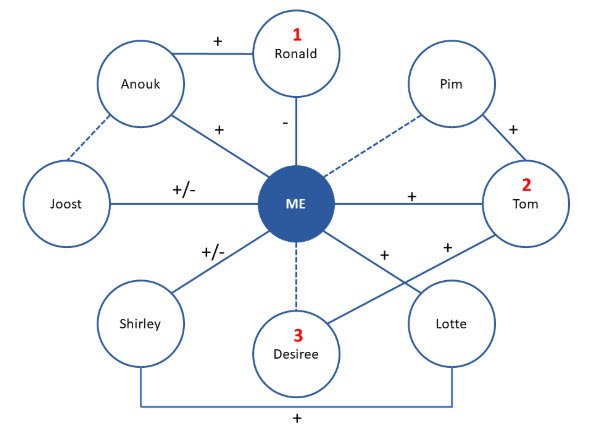
Credit: Ruben de Boer, Oct 27, 2027, Li Post - explaining influence maps
Take whatever you're trying to get support for. It doesn't matter if it's a budget ask, support for a test idea, a new tool rollout, or a seat at a table you're not currently at. Build a map. Every stakeholder is a node, including you. Mark each person with a plus, minus, or mixed for how they currently feel about the issue. Then draw the connections between people (how they connect to you, and to each other): a solid line for a real, trusting relationship, a dotted line for a weaker or more surface-level one. Obviously, leave blank the nodes that have no connections. Now look at the map you just built. Somewhere on it there's a person who is solidly connected to you AND already a plus on the issue AND solidly connected to someone who's still on the fence, someone you personally only have a dotted line to, or no connection at all to. That person is your unlock. They don't need to be convinced about your cause. They need an ask to help you convince others.
People tend to support what they help create. That's the whole mechanism of how minds actually get changed at scale. Not one giant persuasive push from you to everyone at once. A chain of real relationships doing what they already do naturally.
And you cannot build that map from a CRM export. You need the verbal, unglamorous stuff: who's had friction with who, who's protective of what, who owes who a favor, who's new and still figuring out where they stand. At minimum, a written description of stakeholders and a real org chart living somewhere your team (and honestly, your AI tools) can reference is genuinely one of the highest-value things you can hand someone stepping into a client relationship, backfilling for a teammate, or trying to get useful support out of an AI assistant that's otherwise flying blind on the politics.
But remember, this isn't all about work either. It's about truly, authentically getting to know each other. Do your colleagues or clients have kids? A partner? Do they like spicy food? Are they a Marvel person or a DC person? (The correct answer is both.) Are they going to be in a foul mood today because their favorite sports team lost last night? Understanding this stuff, connecting with people beyond the ask, is how we know we're being authentic. How we know we’re more than robots talking to robots.
How do you actually get that information? By getting to know each other. By spending time together. By bringing your authentic self to work, to conferences, to networking events. And, to be frank, by actually participating in those events in the first place. It's so easy in this AI age to hide behind our keyboards and never really get to know our peers. It's a mistake. Authenticity is the only thing keeping our content real. Our connections meaningful. And it truly, still, is how influence works.
I teach an executive comms workshop built on this (credit to Margaret Keys; this framework is hers; I just hold people to it), and a core component of it talks about what is required to persuade executives. Two pieces, both required: Alignment, meaning the message and the content. Right message, right room, right time. Is this actually what they're expecting to hear? Right format, right scope? Any surprises buried in there? Because surprises are bad. And Attunement, meaning audience analysis. It's understanding who YOU are, bringing your own authority into the room, but also genuinely recognizing who THEY are and meeting them WHERE they are. Not speaking down to them. Not going over their head either. If you're talking to an executive who's in a hurry and just wants help making a decision, tell them what time it is. Don't explain how the watch was made (Credit: Val Kroll). You can be perfectly aligned on paper and still fail if the delivery isn't attuned, and you can be perfectly attuned and still fail if your ask comes at the wrong time or in the wrong template. You need both. Connect, don't perform. That's the whole difference.
And you cannot fake your way to that understanding. It doesn't come from a shared dashboard or a shared OKR. It comes from actual conversation, and honestly, the conversations that build the most trust the fastest are rarely the professional ones. They're the ones where you find out you're both white-knuckling the same kind of hard thing. I bond with people constantly over stories of issues with nuro-spicy-related issues with my partner, my sons, and now - at soon-to-be-50 this year - with me! Whatever your version of that is, that's the moment two people stop performing their titles at each other and start being two actual humans who happen to also need something from each other professionally. Once that happens, the real conversation about goals becomes possible in a way it simply wasn't five minutes earlier.
This isn't an add-on to the strategy. It is the strategy. Whether you're managing a client relationship, navigating internal politics as a cross-functional leader, or just trying to get buy-in from someone three levels removed from you, the mechanism is identical: get outside your comfort zone enough to actually get to know someone, and your authentic self and their authentic self can finally have the real conversation instead of the performance of one.
And by the way, this isn’t just an influence strategy. It’s also about your wellbeing. I’ve mentored a lot of young people who are afraid to bring their authentic self to work. So I’ve done a lot of research to help advise them. My own experience isn’t enough. Yes - it’s harder for women and minorities, and it’s scary for younger folks just entering the workforce. But also - if your employer or manager won’t be comfortable with your authentic self… Research shows that hiding your authentic self won’t just make you unhappy; it will reduce the quality of your work! Since I know my crowd wants the receipts: a 2017 longitudinal study out of Germany that tracked 1,243 employees found that people who behaved more authentically at work had significantly lower depressive symptoms six months later and significantly higher work ability. It wasn't only one direction either, feeling better also predicted more authentic behavior the next time around. A true reinforcement loop from authenticity (Emmerich and Rigotti, Frontiers in Psychology, 2017).
You get better outcomes, and you feel less alone doing the work. See? It works. Bring your authentic self to work, and you're not only better able to build connections, which is where influence actually comes from, but you feel better and get better outcomes, too.
So, in a world drowning in AI slop, take time to connect with your actual peers. Attend a webinar. Join a Slack conversation. Go to a conference. Go to an industry or company happy hour. The important thing is to talk to people. Real people, about real things. Get to building those solid line connections. Let me know how it goes.
It works. It always has.